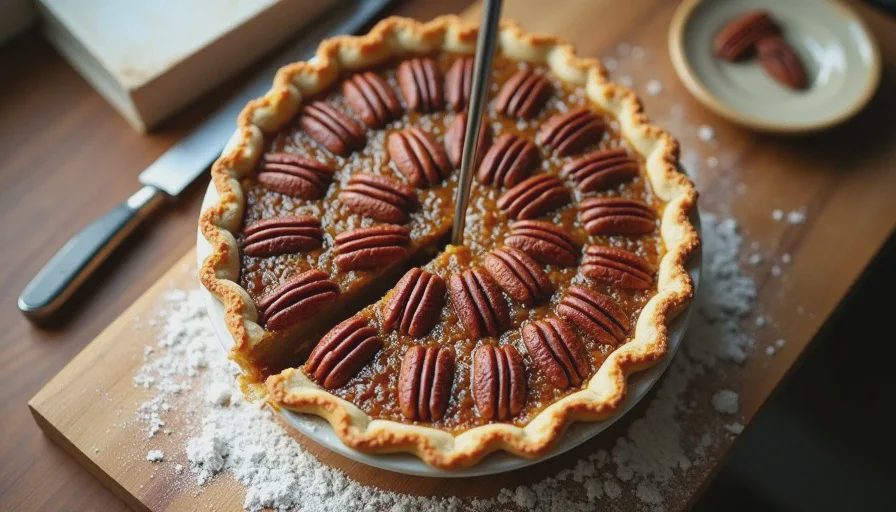
A pecan pie recipe with flaky crust doesn't require a Southern grandmother standing over your shoulder — but it does require knowing where the shortcuts work and where they'll sink you. I grew up with my mom's pie crust technique and her kolache recipe, but pecan pie wasn't in her rotation, so I figured it out the hard way: three burnt tops, two runny centers, and one soggy-bottom disaster at a Thanksgiving potluck before I built a cheat-sheet version that works. If you're also looking for a kolache recipe Central Texas style, the crust technique in this article carries over. This pecan pie recipe with flaky crust is my simplified version — fewer steps than a traditional recipe, and it produces a pie that tastes like pecans instead of like candy.
Why Most Pecan Pies Fail
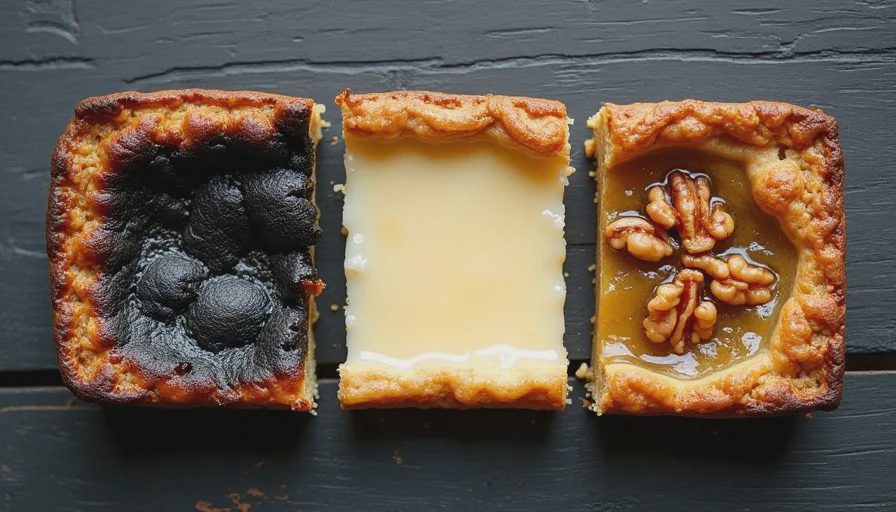
The Three Common Killers
Every pecan pie I ruined fell into one of three holes, and I'm going to tell you exactly how I fell into each one:
Failure Mode | What I Did Wrong | What I Do Now |
|---|---|---|
Burnt pecan top | Baked at 375°F for 55 min | 350°F for 45-50 min, foil tent at 35 min |
Runny center | Pulled it when it "looked done" | Probe thermometer reads 200°F in center |
Soggy crust | Filled a cold, unbaked crust | Par-bake the crust at 375°F for 12 min, cool, then fill |
That runny center cost me at a church potluck three years ago. I cut into that pie in front of twelve people and the filling poured out like I'd cut a juice box. June, who was six at the time, said "Daddy, it's soup." She wasn't wrong. That's when I bought a probe thermometer and started treating pie filling like I treat brisket — temperature, not looks.
Why Temperature Matters More Than Time
Here's the thing I didn't understand: pecan pie filling is a custard. Eggs, sugar, butter, corn syrup — it sets between 195°F and 200°F, not at a specific minute mark. Every oven runs differently, every pan conducts differently, and the only way to know if your filling is set is to measure it. I use a probe thermometer in the center of the pie, the same ThermoWorks unit I use for pork shoulder. When it reads 200°F, it's done. When it wiggles slightly but holds shape when you nudge the rack, it's done. When the center is still sloshing, it is not done, and no amount of hope will change that.
The Cheat-Sheet Recipe
Ingredients Table
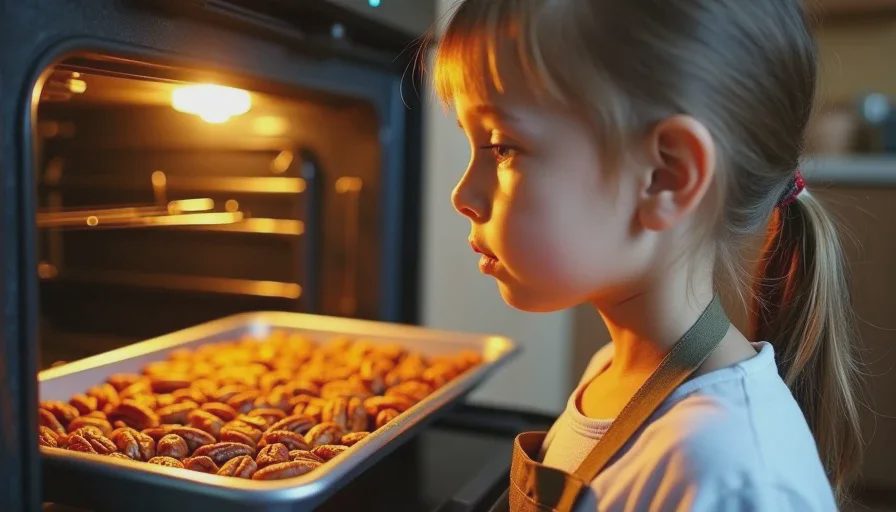
Here's my simplified version — fewer ingredients than a traditional recipe, and it works every time. June toasts the pecans now, and she hasn't burned a batch in four months. I'm proud of that.
Ingredient | Amount | Notes |
|---|---|---|
Unbaked pie crust (mom's recipe or store-bought) | 1 single crust | If store-bought, par-bake it. If mom's, don't — her crust handles it. |
Pecan halves | 2 cups | Toast at 350°F for 8 min, cool completely |
Corn syrup (Karo, light) | 1 cup | Light, not dark — dark makes it too sweet |
Granulated sugar | 1/2 cup | Not 3/4 cup — that's too much. Trust me. |
Brown sugar, packed | 1/4 cup | Adds depth without overwhelming |
Eggs | 3 large, room temp | Room temp matters — cold eggs seize the butter |
Unsalted butter, melted | 1/3 cup | Cooled slightly, not hot |
Vanilla extract | 1 tsp | Not imitation. Spend the dollar. |
Salt | 1/2 tsp | Don't skip this. Sweet needs salt. |
The key adjustment I made from traditional recipes is the corn syrup-to-sugar ratio. Most recipes call for 1 cup corn syrup plus 3/4 cup sugar, and that's tooth-achingly sweet. I dropped the white sugar to 1/2 cup and added 1/4 cup brown sugar for depth. The result is a pecan pie that tastes like pecans, not like candy. This is the cheat-sheet part of my pecan pie recipe with flaky crust — it's not about removing steps, it's about adjusting ratios until the flavor is right.
The Method: Step by Step
Toast the pecans: 350°F for 8 minutes on a sheet pan. Let them cool completely. Warm pecans will melt the butter in the filling and make it greasy. June handles this step and she's gotten good at smelling when they're done — nutty, not burnt.
Par-bake the crust: If using store-bought or if your crust is soft, bake at 375°F for 12 minutes, then cool to room temp. If you're using my mom's crust recipe (it's in the binder, and it's got enough butter to hold its shape), skip this step.
Mix the filling: Whisk eggs, sugars, corn syrup, melted butter, vanilla, and salt until smooth. Don't whip — you don't want air bubbles. Fold in the toasted pecans.
Pour and bake: Pour filling into the crust. Arrange pecan halves on top if you want it to look good (I do, because Kate judges presentation). Bake at 350°F for 45-50 minutes. Tent with foil at the 35-minute mark if the pecans are browning too fast.
Check doneness: Probe thermometer in the center reads 200°F. The edges should be set and the center should jiggle slightly — like Jell-O, not like water.
Done-Ness Guide: Knowing When It's Finished
This is the single most important thing in this entire article. If you pull it too early, you get soup. If you leave it too long, you get tar on top. Here's how I read it:
Visual Cue | Temperature | Status | Action |
|---|---|---|---|
Center sloshes when nudged | Below 185°F | Raw — not close | Keep baking, check in 10 min |
Center ripples, edges loose | 185-195°F | Almost there | 5-10 more minutes |
Center jiggles slightly, edges set | 200°F | Done — pull it | Remove, cool on rack |
Center doesn't move at all | Above 210°F | Overcooked | Next time pull at 200°F |
Top is dark brown/black | Varies | Pecans burning | Foil tent immediately |
The Probe Thermometer Trick
Here's the trick that changed everything: insert the probe into the center of the pie before you put it in the oven. Run the wire out and set the alarm for 200°F. You don't have to open the oven door and lose heat, you don't have to guess, and you don't have to jiggle the rack. When the alarm goes off, it's done. I do this for every custard-type pie now — pecan, pumpkin, sweet potato. The wire on my probe is rated to 500°F, so it handles the bake no problem. Same probe, same alarm, same principle as pulling a pork shoulder at 205°F. Temperature is temperature, whether it's meat or custard.
Cooling and Serving
Cool the pie on a rack for at least 2 hours before cutting. I know, that's a long time. But if you cut into it warm, the filling hasn't fully set and it'll slump. I cool mine overnight if I can, and it slices clean the next day. Serve at room temperature. Whipped cream is optional — Kate insists on it, I think it dilutes the pecan flavor, and we've had this argument eleven times. She usually wins because she's usually right about these things.
What I'd Tell You If You Were Standing in My Kitchen
Don't overthink this. Toast the pecans, drop the sugar, use the probe, pull at 200°F. That's the whole cheat sheet. You don't need a Southern grandmother — you need a thermometer and the patience to let it cool before you cut. My mom's pie crust recipe is in the binder on my counter, and if you want a kolache recipe Central Texas style to go alongside, that's in there too. But honestly, a store-bought crust with this filling ratio and a probe thermometer will get you most of the way home. The rest is practice, and that's the fun part. This pecan pie recipe with flaky crust isn't about being fancy — it's about being reliable, and reliable is what gets you invited back to the potluck.
Good smoke. Good sweets. Good people.

No notes yet — write the first one.