
Offset smoker fire management starts with understanding that fire is a living thing, and nobody taught me that lesson better than a beat-up cast-iron offset smoker my grandfather built in his garage in 1973. This is the story of Old Hoss, what that smoker taught me about reading fire, and why it still sits in my backyard in Lockhart even though I've got a newer model that does everything better on paper. If you're writing a Lockhart BBQ blog and talking about fire, you start here — with the iron that taught you. Offset smoker fire management isn't about dials and readouts on Old Hoss; it's about your hand on the metal, your eyes on the smoke, and a rhythm you feel in your bones.
The Backstory of Old Hoss
What My Grandfather Built
My grandfather, Hollister Senior — everyone called him Hoss — built Old Hoss from a 250-gallon propane tank, a piece of pipe for a chimney, and a firebox he welded from quarter-inch plate steel. He cut the doors with a torch, hinges from a tractor, and the grates are expanded metal from a cattle feeder. It's ugly. It's heavy. It works.
Granddad died in 2009, before I got serious about smoking meat, and Old Hoss sat under a tarp in my grandmother's backyard for three years. When she passed, my uncle loaded it onto a trailer and hauled it to my place in Lockhart. Kate cried when she saw it. I just stood there with my hand on the firebox, feeling the metal warm in the afternoon sun, and thought about every brisket my grandfather ever pulled off that grate for Thanksgiving, for birthdays, for no reason at all.
What I Learned Before I Knew Anything
The first time I lit Old Hoss, I burned a brisket to a crisp in two hours. I didn't understand that this smoker doesn't need much fire — it needs the right fire. Cast iron holds heat like a grudge. You build a fire that seems too small, let the metal soak it in, and Old Hoss will cook at 250°F with barely visible coals. I learned that the hard way, and I ruined three briskets before the lesson stuck.

What Old Hoss Taught Me About Fire
Reading Smoke Color
The first lesson Granddad's smoker taught me was reading smoke. Here's what I know now that I didn't know then:
Smoke Color | What It Means | What to Do |
|---|---|---|
Thick white/grey | Creosote forming, fire not clean | Open the firebox damper, add dry wood, let it breathe |
Thin blue (barely visible) | Clean combustion, good smoke | Maintain it, add a split every 30-40 minutes |
Black or dark grey | Starved fire, incomplete combustion | Too much wood, not enough air — clear the ash and let it draw |
No smoke at all | Coals only, no wood flavor | Add a split for flavor, not for heat |
Thick white smoke is the beginner's mistake. I chased that "looking good" cloud for my first year, not understanding that I was laying down creosote — bitter, acrid, and it coats the meat like tar. Old Hoss taught me to look for smoke you can barely see, the kind that makes you think the fire went out. That's when you're cooking clean, and that's when offset smoker fire management becomes second nature.
Feeling the Metal for Temperature Zones
Old Hoss doesn't have a built-in thermometer that I trust. The original dial was off by 50 degrees and I pulled it out years ago. What I do is lay my hand flat on the outside of the cook chamber, moving from the firebox end toward the stack end. Near the firebox, the metal is hot enough that you can't hold your hand on it for more than two seconds — that's 300°F+ on the grate inside. Move eighteen inches toward the stack, and you can hold your hand there for four seconds — that's your 225-250°F zone. That's where I put briskets and pork butts. Near the stack, six seconds — that's 200°F, good for holding or warming.
This sounds primitive, and it is. But it's also how my grandfather cooked without a single thermometer for thirty years, and his brisket was better than mine was for the first five years I tried.
The Rhythm of Adding Logs
Offset smoker fire management on Old Hoss is about rhythm, not thermometers. Here's the cycle:
Every 30-40 minutes: Add one split of post oak, about the diameter of a beer can, pre-warmed on top of the firebox.
Every 60 minutes: Rake coals toward the opening to the cook chamber, creating a clean draw path.
Every 2 hours: Clear ash from under the grate — ash blocks airflow and suffocates the fire.
Before opening the cook chamber door: Check smoke color first. If it's thick, wait. If it's thin and blue, you can open without losing your temp zone.
That rhythm becomes muscle memory. I can be watching a Longhorns game, glance at my watch, know it's time for a split, and walk outside and back without missing a play. Kate says I'm not really watching the game. She's right, but the brisket doesn't care about the score.

Old Hoss vs. The Newer Smoker
What Changed and What Didn't
Three years ago, I bought a newer offset smoker — welded steel, thicker insulation, built-in thermometer that's actually accurate, and a firebox with a proper damper system. It's a good machine. Here's how they compare:
Feature | Old Hoss (1973) | Newer Smoker (2023) |
|---|---|---|
Material | Cast iron from propane tank | Welded 1/4" steel plate |
Heat retention | Holds heat for hours, slow to heat up | Heats faster, cools faster |
Fire management style | Feel-based, visual, intuitive | Thermometer-driven, precise |
Typical brisket cook time | 14-16 hours at 225°F | 12-13 hours at 225°F |
Learning curve | Steep — fire punishes mistakes | Gentle — more forgiving of temp swings |
Flavor profile | Heavy smoke, deep ring | Cleaner, lighter smoke |
Who uses it | Me, always | Me when I'm in a hurry |
The newer smoker is easier. Old Hoss makes better meat. I cook on both because sometimes I need the precision and sometimes I need the lesson. Granddad would have called the newer one a "sissy machine," but he also would've appreciated that it lets me sleep more than four hours on a cook night.
Fire Management Principles I Live By
These are the rules Old Hoss burned into me — some literally:
Small fire, clean fire. A fire that looks too small is usually right. A fire that looks impressive is usually wrong.
Wood pre-warmed on the firebox. Cold wood on hot coals creates dirty smoke. Warm wood catches clean.
Airflow over fuel. You manage temperature with air, not with wood. More wood without more air just makes creosote.
Patience over power. If the temp drops, don't throw a pile of wood at it — add one split and wait. The metal will catch you back up.
Trust the stall. The meat knows what it's doing. Your job is to keep the fire honest.
The Backyard as a Place of Memory
Every Saturday morning, I'm out behind the house by 5:45 AM. The kids are still asleep, Kate's got the coffee going, and I'm standing next to Old Hoss with a cup in one hand and a match in the other. The metal is cool and damp with morning dew, and I think about my grandfather doing the same thing in the same way, probably in the same boots.
Last spring, Sam came out at 6:30 AM in his pajamas, stood next to me, and said "Dad, can I put the first split on?" He's seven. He put the log on too fast and it rolled off and I caught it. He looked at me like he'd broken something. I told him Granddad's first split rolled off too, and that's how you learn. That's the whole story of Old Hoss in one moment — you try, you fail, the iron holds steady, and you try again.
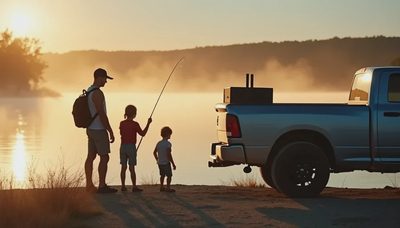
When I'm fishing with the kids at Lake Travis on a Sunday afternoon, casting for catfish with Sam and watching June work her reel, I think about how Granddad used to do the same thing with my dad. Same lake, same fish, different years. The smoker and the fishing rod — those are the two things that connect us across time, and I don't take that lightly.
Good smoke. Good sweets. Good people.
No notes yet — write the first one.